Why a good cutter still fails in a poor setup
Many shops blame the tool first when a job starts chattering, leaving a rough finish or breaking corners too often. In practice, the problem is often rigidity around the tool rather than the carbide itself. A rigid setup lets the cutter stay true, take a consistent chip and hold size across the full run.
That matters in busy machining centres from Germiston to Cape Town where parts must be repeated all week, not just once on a test piece. A tool that is ideal on paper can perform badly if the holder has runout, the spindle nose is dirty, or the job is clamped on a weak section of the component. Small losses in stiffness add up quickly at high rpm.
For stainless steel, tool steel and aluminium alike, a stable setup helps with surface finish, cutter life and cycle time. The cutting edge does the work, but the holder and fixture decide whether that work stays controlled or turns into vibration.
Holder choice changes how the cutter behaves
The holder is more than a place to grip the shank. It affects concentricity, damping and the way cutting forces travel back into the machine. A poor holder can defeat even a very accurate end mill. In South African workshops, where one machine may move from mould work to general engineering in the same shift, that consistency is worth money.
Before setting up a job, check these points:
- Match the holder type to the cut, not only to the tool diameter.
- Keep the tool engagement as even as possible across roughing and finishing passes.
- Clean the taper, collet and nut every time the tool is changed.
- Check for visible wear or scoring on the clamping faces.
- Use the shortest practical holder for the job.
We often see shops in Wadeville and Boksburg lose accuracy because the holder choice was made for convenience instead of stiffness. It only takes a slightly loose fit or a tired collet to cause taper marks, extra wear and noise that gets worse as the tool goes deeper into the cut.
Overhang: the hidden cause of chatter and breakage
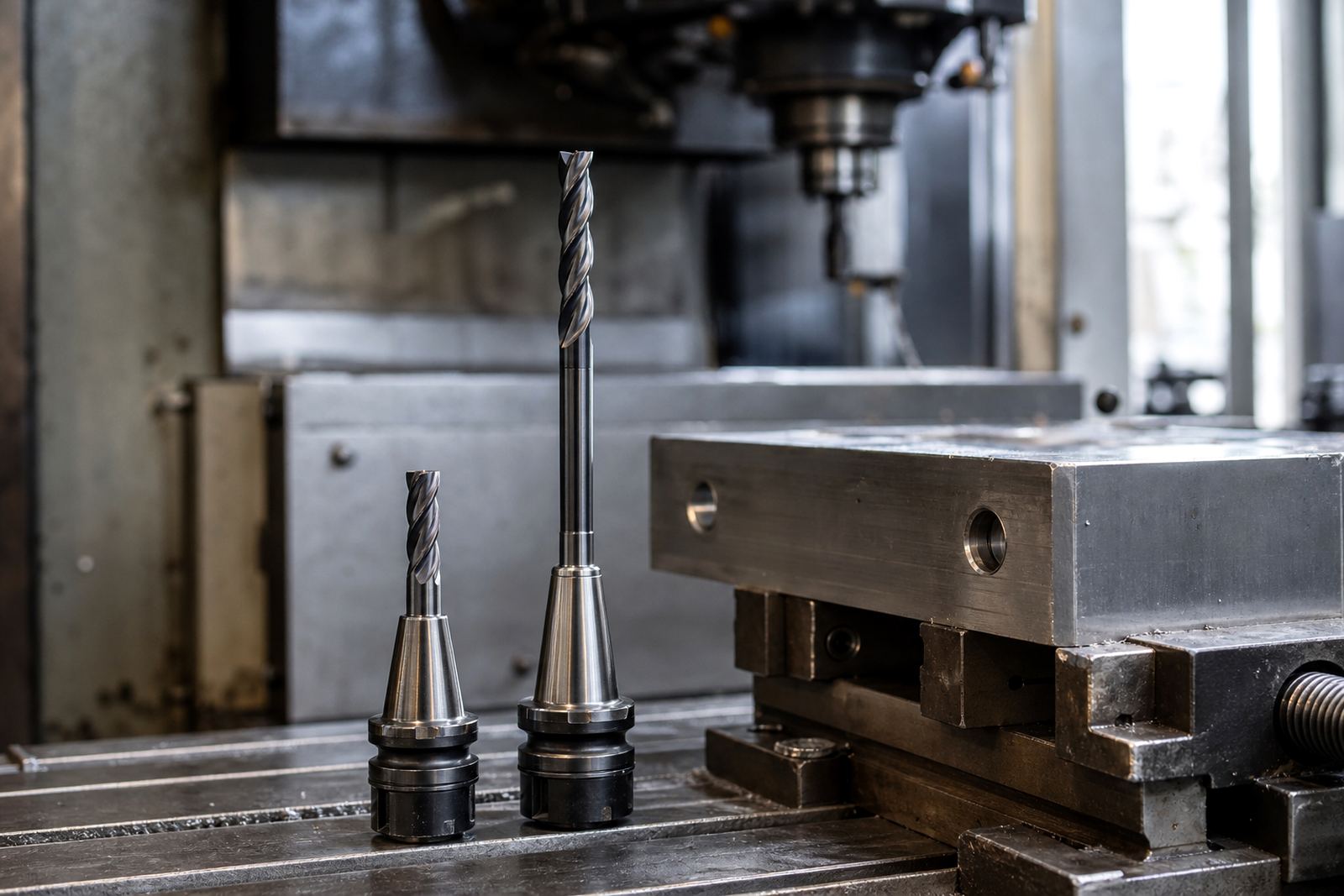
Overhang is one of the most common reasons solid carbide tools fail early. The further the tool sticks out from the holder, the more it can flex. Even a small increase in stick-out can change the cut from stable to shaky, especially on deeper slots, long reach pockets or heavier side milling.
As a rule, use the shortest possible projection that still clears the component and allows chip evacuation. It is tempting to leave extra length for safety, but that extra length can cost you tool life and finish. If you need reach, adjust the program, the strategy or the workholding before you simply extend the tool and hope for the best.
Practical signs that overhang is too long include:
- Rattling or a high pitched squeal during cutting.
- Polished flank wear on one side of the cutter.
- Chipped corners after only a few parts.
- Size variation between the first and last part in a batch.
- Tool marks that show a repeating wave pattern on the wall.
In many cases, reducing overhang by just a few millimetres improves the cut enough to raise feed rates without changing the tool at all. That is a simple win when load-shedding interrupts production and every hour of spindle time has to count.
Workholding must stop movement, not just hold the part
A strong cutter cannot compensate for a part that moves under load. If the component lifts, twists or rings during cutting, the tool sees uneven force and the edges suffer. Good workholding supports the part close to the cut, spreads the clamping force properly and leaves enough access for the tool to clear chips.
This is especially important on thin wall parts, long profiles and small batch work where operators may be tempted to clamp lightly to avoid marking the material. A softer clamp that allows movement is usually worse than a firm setup with proper packing, better jaws or a more suitable fixture. On coastal jobs in Durban or Gqeberha, humidity can also affect surface condition and clamping cleanliness, so the setup needs a little extra care.
When checking workholding, ask whether the part can move in any direction during the cut. If there is doubt, improve the fixture before chasing the problem with slower speeds or smaller stepovers. The machine should not be fighting the setup the whole day.
Chip load, speed and rigidity must work together
Feed and speed advice is only useful when the setup can carry the load. A rigid machine with good holding allows a cutter to work at the chip load it was designed for. A weak setup often forces the operator to back off, which can make the tool rub instead of cut. That usually leads to heat, built up edge and short tool life.
For many jobs, the right answer is not simply slower cutting. It may be shorter overhang, a better holder, a firmer clamp, or a change in toolpath that keeps the load more even. This is where application support makes a real difference. One machine in Pretoria may run the same tool well, while a similar job in Johannesburg needs a different approach because the fixture, spindle condition or material batch is not the same.
Useful questions to ask before a production run:
- Is the machine carrying the cut cleanly or showing vibration?
- Does the tool enter and exit the material smoothly?
- Are chips clearing properly, or packing into the flute?
- Is the cutting load too heavy for the amount of stick-out?
- Will the setup still hold tolerance on the fiftieth part?
If the answer to any of these is no, the best fix is often mechanical rather than programming based.
A Germiston example: one small change, better tool life
A machining shop in Germiston was cutting medium carbon steel on a vertical machining centre and losing end mills before the batch was complete. The operator had already reduced feed rates, but the finish still showed chatter marks and the corners were wearing unevenly. The first instinct was to change the cutter grade, yet the real issue was the setup.
The tool was sticking out too far from the holder and the workpiece was clamped only at the ends. By shortening the projection, cleaning the taper, improving the packing under the part and moving the clamp position closer to the cut, the shop got a cleaner finish and a longer tool life on the same tool size. The cycle time also improved because the cutter could be run closer to its intended parameters.
This kind of fix is common in local production. It does not always need a new machine or a more expensive tool. Sometimes the answer is simply better rigidity and a more disciplined setup routine.
Build rigidity into the process, not just the machine
Rigidity is not a once-off setting. It should be part of every setup decision, from tool selection to final inspection. When a shop treats holder choice, overhang and workholding as part of the process, it gets more predictable tool life and fewer surprises on the floor.
At CuTools Carbide, we work with CNC machining shops across South Africa on tool selection, material matching, speed feed advice, tool life optimisation and urgent tool supply. If a setup is giving trouble, it is usually worth checking the mechanical side first. A stronger, cleaner arrangement often gives better results than chasing the problem with a different end mill alone.
Good rigidity does not just protect carbide. It protects production schedules, labour time and the parts going out the door.